
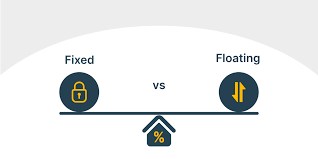
Choosing the right type of interest rate is one of the biggest decisions people make when taking a personal loan. Most borrowers focus on the loan amount and the EMI, but they ignore one important factor: whether to choose a fixed interest rate or a floating interest rate. This choice can affect your monthly payments, the total cost of the loan, and even your long-term financial stability.
If you have ever felt confused about fixed vs floating interest rates, don’t worry—you are not alone. Many borrowers struggle to understand how these rates work, when each option is suitable, and which one will cost less. This article breaks down both types in simple, humanized language so you can make a confident decision.
What Are Fixed Interest Rates?
A fixed interest rate means your interest rate stays the same throughout the loan tenure. Your EMI will not change—no matter what happens in the market.
Think of it like getting a locked price. Once the rate is fixed, you are protected from future rate increases.
How Fixed Rates Work:
If your rate is 15% at the start, it stays 15% till the end.
Your EMI remains constant every month.
Your total repayment amount is predictable.
Advantages of Fixed Interest Rates
Stability and peace of mind
You know exactly how much you will pay each month. This makes it easier to plan your finances.
Good for tight budgets
If your income is limited or fixed, steady EMIs help keep your financial stress low.
Safe during rising market rates
If economic conditions change and rates rise, your EMI will stay the same.
Disadvantages of Fixed Rates
Usually slightly higher
Fixed-rate loans generally come with higher interest compared to floating rates.
No benefit if market rates fall
Even if rates go down, your EMI remains unchanged. You lose potential savings.
Early payment charges
Some lenders charge a penalty if you want to prepay a fixed-rate loan.
What Are Floating Interest Rates?
A floating (or variable) interest rate changes based on market conditions. Your EMI may increase or decrease depending on changes in the lender’s benchmark rate.
Think of it like a boat on water. When the tide rises, your EMI rises. When the tide falls, your EMI falls.
How Floating Rates Work:
If the benchmark rate goes down, your interest rate also goes down.
Your EMI or tenure may change periodically.
Your total repayment cost is not fixed in advance.
Advantages of Floating Interest Rates
Lower starting interest rate
Floating rates are usually cheaper than fixed rates at the beginning. This means lower initial EMIs.
You benefit when rates fall
If market conditions improve, your EMI drops and you save money.
Minimal prepayment penalties
Most lenders don’t charge extra if you want to repay earlier.
Disadvantages of Floating Rates
Uncertainty in EMI
Your payments may increase unexpectedly, which can affect your budget.
Not ideal for risk-averse borrowers
If you don’t like surprises, floating rates can be stressful.
Higher cost during rising interest periods
If inflation or economic conditions worsen, rates may go up significantly.
Fixed vs Floating Rates: A Simple Comparison
Feature Fixed Rate Floating Rate
Interest Stability High Low
EMI Change Never Sometimes
Initial Rate Higher Lower
Benefit If Rates Fall No Yes
Suitable For Stable income, low risk Flexible income, risk takers
Prepayment Charges Often applicable Usually none
Which One Is Better for You?
There is no single “best” option. The right choice depends on your financial situation, risk tolerance, income stability, and market conditions.
Let’s break it down.
Choose Fixed Interest Rate If:
You want complete stability in monthly EMIs
You have a fixed or limited income
You prefer predictable long-term financial planning
You expect market interest rates to rise soon
You dislike financial risk
You are taking a long-term loan and want EMI consistency
A fixed rate is like choosing a safe and steady path. You may pay slightly more, but you will avoid market uncertainty.
Choose Floating Interest Rate If:
You are comfortable with changing EMIs
You expect interest rates to fall in upcoming years
You have flexible income
You want lower starting EMIs
You don’t mind short-term financial fluctuations
You plan to prepay your loan early
Floating rates give you more opportunities to save money—especially during economic downturns.
Real-Life Example
Imagine two friends: Ali and Hamza.
Ali chooses a fixed rate.
His interest rate stays the same for 5 years. His EMI never changes. He always knows what to expect.
Hamza chooses a floating rate.
His EMI is lower initially, but after two years the market rate increases and so does his EMI. Later, the market improves and his EMI goes down again.
Who benefits more?
It depends on market conditions. If rates mostly fall, Hamza will save money. If rates rise, Ali will benefit.
How to Decide Smartly
Here are some quick, practical tips to help you choose:
✔ Check your income stability
Stable income = fixed rate
Fluctuating income = floating rate
✔ Study current market trends
If rates are already high, they may fall → choose floating.
If rates are low, they may rise → fixed is safer.
✔ Consider loan tenure
Short tenure = floating often works better
Long tenure = fixed offers more stability
✔ Evaluate your risk tolerance
Hate surprises? Pick fixed.
Comfortable with changes? Floating is fine.
Conclusion
Choosing between fixed and floating interest rates is one of the most important decisions you’ll make when applying for a personal loan. Both options have their own advantages and disadvantages. Fixed rates give stability and peace of mind, while floating rates offer flexibility and the possibility of saving money when market rates drop.
The “better” option is the one that matches your financial comfort, income pattern, and future expectations.
If you understand your needs clearly, the right choice becomes easy.